If you’ve ever spent time navigating the world of automotive, marine, or RV lighting, you’ve probably run into BA15D and BAY15D bulbs at some point. As a supplier who fields dozens of questions a week from customers, I can say one of the most common ones is: “Are BA15D and BAY15D bulbs compatible with LED replacements?” It’s a fair question—LEDs offer massive benefits over incandescent or halogen bulbs: longer lifespans, lower energy use, brighter light output, and less heat buildup, which is a huge plus for enclosed spaces like taillight assemblies, boat navigation lights, or RV cab lights. But the answer isn’t a simple “yes” or “no.” It depends on a few key details that trip up a lot of people, and I’ve seen firsthand how getting these details wrong leads to frustrated customers and unnecessary returns. Let’s break this down clearly, based on years of working with these bases and talking to electricians, marine mechanics, and RV owners every day. BA15D/BAY15D Bulb
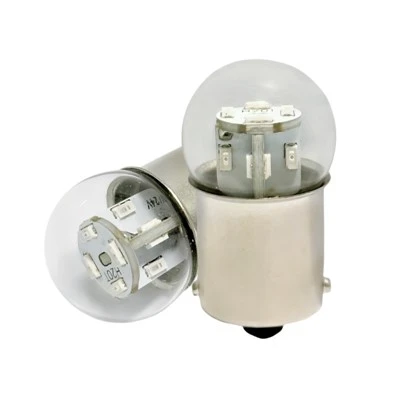
First, let’s make sure we’re on the same page about what BA15D and BAY15D even are, because that’s where most of the confusion starts. Both are double-contact bayonet bases—meaning they have two electrical contacts at the bottom of the bulb, instead of the twist-in type like E26 or E12 Edison bases. The “D” stands for double, referring to the two contacts, and the “15” is the diameter of the base in millimeters. Where they differ is the pin that sticks out the side of the base, which is what locks the bulb into the fixture. A BA15D has a single, solid metal pin on one side of the base. A BAY15D has two parallel pins on that same side. If you’ve ever tried to force a square peg into a round hole, you get the idea: you can’t swap a BA15D bulb into a BAY15D fixture, or vice versa, because the locking pin won’t line up. That’s a basic compatibility rule that’s non-negotiable, no matter what type of bulb (incandescent, halogen, LED) you’re using.
Now, the bigger question: can you replace an incandescent or halogen BA15D or BAY15D bulb with an LED version of the same base? For the most part, yes—but there are important exceptions, and those exceptions cause a lot of headaches. Let’s start with the scenarios where it works perfectly. Most basic applications work: interior RV lights, under-hood compartment lights, basic boat courtesy lights, non-dimmer exterior lights like marker lights, and some older taillight assemblies that don’t use complex wiring. In these cases, swapping out your old incandescent BA15D bulb for a BA15D LED is straightforward, as long as the LED is rated for the same voltage (most BA15D/BAY15D bulbs are 12V, which is standard for automotive, marine, and RV use, though some heavy-duty applications use 24V, so always double-check the fixture’s voltage rating).
Where compatibility gets tricky is with two specific setups: fixtures with built-in load resistors and vehicles/machines with bulb failure warning systems (also called “lamp out” indicators). Let’s talk about load resistors first. Older incandescent BA15D bulbs draw a lot of current—usually between 2 and 5 watts each, depending on the bulb. LEDs, by contrast, draw a fraction of that current, often less than 1 watt. When you install an LED in a fixture that was wired for an incandescent bulb, the fixture detects that tiny current draw and thinks the bulb is burned out. That’s why you’ll get that annoying “bulb out” warning on your dashboard, or a flashing light on your boat’s control panel, which is super inconvenient. The fix for this is adding a load resistor, also called a canbus decoder, in line with the LED bulb. But here’s the key: not all BA15D/BAY15D LEDs are designed to work with load resistors. Some cheap off-brand LEDs have built-in resistors that aren’t sized correctly for BA15D/BAY15D fixtures, so they either cause the bulb out warning anyway or burn out the LED prematurely. As a supplier, I always recommend that customers specify if their application has a bulb failure system, so we can point them to BA15D/BAY15D LED kits that come pre-wired with the correct load resistors, or the compatible decoders, to eliminate that issue.
Another common pitfall is polarity. BA15D and BAY15D bulbs have two contacts, but they aren’t always neutral polarity. Wait—what does that mean? Incandescent bulbs work no matter which way you wire them, because their filaments just heat up regardless of current direction. LEDs are diodes, though, so they only work if current flows through them in the right direction. That means if you install an LED BA15D bulb backward in the fixture, it won’t light up at all. This is a surprising mistake a lot of people make, especially if they’re used to swapping out old bulbs without checking wiring. For BA15D bases, the two contacts are typically equal in size, but one is connected to the positive terminal and one to negative. For BAY15D bases, the two parallel pins also have a designated positive and negative side. I always tell customers to take a quick photo of the old bulb’s wiring before removing it, or to test the LED with a 12V battery before installing it permanently—if it doesn’t light up, flip it around, and that’s the fix. It sounds simple, but it’s one of the most frequent questions I get, because it’s not something you have to think about with incandescents.
There’s also a myth out there that BA15D and BAY15D LEDs are all the same size, so they’ll fit any fixture. That’s mostly true, but not always. Some specialty BA15D bulbs, like high-wattage halogen ones used in floodlights or work lights, have a thicker glass envelope or a larger base collar than standard BA15D bulbs. Most LEDs are designed to match the standard size of incandescent BA15D/BAY15D bulbs, but if you’re replacing a bulb from a specialty application (like a vintage RV’s original headlight bulb, or a commercial work light), you need to confirm the LED’s dimensions match. The last thing you want is to buy an LED that won’t fit into the fixture’s mounting slot because it’s too wide.
Now, let’s address a specific case that comes up a lot in the marine industry, which is a huge market for BA15D and BAY15D bulbs. Marine fixtures are built to be waterproof, so they have sealed housings. When you replace an incandescent bulb with an LED, you have to make sure the LED is also waterproof-rated. A lot of cheap Amazon LEDs claim to be waterproof, but they’re only water-resistant, meaning they’ll hold up to a little spray, but not full submersion. For boat navigation lights, stern lights, or deck lights, you need BA15D/BAY15D LEDs rated IP67 or higher, which is the standard for marine use. I’ve had customers tell me they replaced a $5 incandescent bulb with a $2 LED that died after one rainstorm, because they didn’t check the waterproof rating. That’s a avoidable mistake.
As someone who’s been in the bulb supply business for over 10 years, I’ve also seen how the quality of the LED makes a huge difference in compatibility. Generic, no-name LEDs often use cheap diodes and incorrect wiring, so they’re much more likely to have polarity issues, fail to work with bulb out systems, or burn out quickly. Higher-quality BA15D/BAY15D LEDs, on the other hand, are tested for polarity, sized correctly for load resistors, and built to match the exact pin configuration of BA15D and BAY15D bases. They also have better heat dissipation, which is important because even though LEDs run cooler than incandescents, poor heat management will shorten their lifespan. One customer I worked with a few years ago bought a bulk pack of cheap BA15D LEDs for his RV’s taillights, and half of them burned out in three months. When he switched to our premium line, they’ve lasted over two years, no issues.
So to circle back to the original question: Are BA15D bulbs LED compatible? Yes, for the vast majority of applications, as long as you get the right LED for your specific use case. The same goes for BAY15D bulbs. The key steps to getting it right are: first, confirm your bulb base is either BA15D or BAY15D (not another style like a single-contact BA15), and match that base exactly to your LED. Second, check your fixture’s voltage rating—12V is standard, but 24V is common for commercial trucks or heavy equipment, so never guess. Third, if your application has a bulb failure warning system, work with a supplier that can provide LEDs with compatible load resistors or canbus decoders. Fourth, test polarity before installing, and confirm the LED is rated for any special conditions, like submersion (marine) or extreme heat (work lights).
I know there’s a lot of information here, but that’s because BA15D and BAY15D bulbs are used in so many different applications, from vintage RVs built in the 1970s to modern fishing boats, so there’s no one-size-fits-all answer. The last thing I want is for someone to spend money on an LED that doesn’t work with their fixture, so I always tell customers to reach out if they have a specific question—whether it’s for a taillight, a navigation light, an interior compartment, or any other use. As a supplier, we don’t just sell bulbs; we help people get the right bulb for their needs, and that means being honest about what works, what doesn’t, and how to avoid common mistakes.

If you’re looking to upgrade to BA15D or BAY15D LEDs for your vehicle, boat, RV, or equipment, don’t hesitate to get in touch to discuss your specific application. We can help you confirm compatibility, recommend the right LED type, and make sure you get a product that’s built to last.
LED Headlight References
- Automotive Lighting Technology Association. (2021). Low-Voltage Bayonet Bulb Compatibility Guidelines. Atlanta, GA: ALTA Publications.
- Marine Electrical Systems Council. (2020). Waterproofing Standards for Marine Navigation Lighting. Miami, FL: MESC Technical Report 412.
- National Fire Protection Association. (2019). Electrical Requirements for Recreational Vehicle Lighting Systems. Quincy, MA: NFPA 1192.
- LED Lighting Industry Association. (2022). Load Resistor Specifications for Automotive LED Retrofits. Washington, DC: LLIA White Paper on Retrofit Compatibility.
- Vintage Mobile Equipment Association. (2021). Compatibility Notes for BA15D/BAY15D Bulbs in Classic Vehicles. Chicago, IL: VMEA Technical Bulletin 07-21.
BULBPLAN Co., Ltd.
As one of the most professional ba15d/bay15d bulb manufacturers and suppliers in China, our products have good reputation in the market. Please feel free to wholesale cheap ba15d/bay15d bulb for sale here and get pricelist from our factory. Quality products and reasonable price are available.
Address: No. 86 Zhongli Road, Nancheng Street, Dongguan City, Guangdong Province
E-mail: Alex@bulbplan.com
WebSite: https://www.nicebulbs.com/
